Inside VR: The Science

Naveen Kumar
| 14-05-2026
 · Science Team
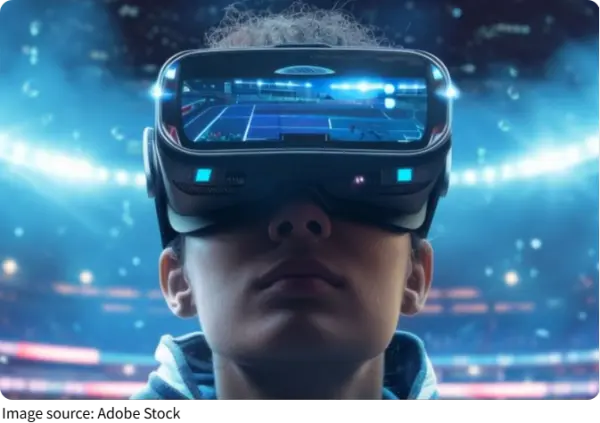
The moment a headset slides over your eyes, the real room fades—not because it disappears, but because your brain accepts a new version of space.
A VR headset doesn't just show images; it convinces your senses to cooperate in building an alternate world.
What feels like magic is actually a carefully engineered illusion.
How Your Brain Is Tricked
A VR headset works by delivering slightly different images to each eye, simulating depth. This process mirrors how human vision naturally perceives distance.
But visuals alone are not enough. Motion tracking updates the scene in real time as your head moves, maintaining consistency between what you see and how you move.
If this synchronization fails even slightly, the illusion breaks. That's why latency—the delay between movement and display—is one of the most critical technical challenges.
Field of View Matters More Than Resolution
Many assume higher resolution defines a better experience, but field of view plays an equally important role. A wider field of view makes virtual environments feel less like looking through a window and more like being inside the space.
Most consumer VR devices balance these two factors carefully. Increasing one often impacts the other due to hardware limitations.
Key display factors include:
1. Field of view — determines how much of the virtual world you can see.
2. Refresh rate — affects smoothness of motion.
3. display density — influences clarity and detail.
Together, these define how convincing the experience feels.
Tracking: The Invisible Backbone
Tracking systems allow a VR headset to respond instantly to movement. There are two main approaches: inside-out tracking (using onboard cameras) and external tracking (using sensors placed in the room).
Inside-out tracking is more flexible and portable, while external tracking can offer higher precision in controlled environments.
Without accurate tracking, even the best visuals cannot create full immersion.
Why Motion Comfort Is a Challenge
One of the most interesting aspects of VR is how it interacts with the human balance system. Your eyes may see movement, but your inner ear might not feel it.
This mismatch can cause discomfort for some users. Developers address this by designing experiences that minimize abrupt motion or by stabilizing the visual horizon.
Comfort is not just about hardware—it also depends on content design.
Applications Beyond Entertainment
While gaming is the most visible use, VR technology extends into multiple fields.
1. Training simulations — practicing complex tasks in controlled environments.
2. Virtual collaboration — shared workspaces without physical presence.
3. Design visualization — exploring products or spaces before they exist.
These applications rely on VR's ability to replicate real-world scenarios with high accuracy.
Audio Completes the Illusion
Sound plays a crucial role in immersion. Spatial audio adjusts based on head position, making sounds appear to come from specific directions.
When audio aligns perfectly with visuals, the brain accepts the virtual environment more readily. If not, the experience feels artificial.
This is why many VR systems integrate advanced audio processing alongside visual rendering.
The Balance Between Power and Portability
Modern VR headsets face a design trade-off: performance versus convenience. High-powered systems deliver more detailed environments but often require external hardware. Standalone headsets offer mobility but must optimize performance within limited processing capacity.
This balance shapes how VR continues to evolve.
A Technology Built on Perception
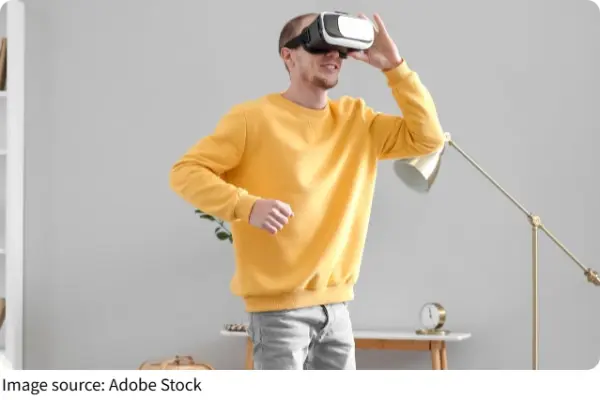
At its core, a VR headset is not just about screens and sensors—it's about perception. It works because the human brain is willing to accept a consistent alternative reality when enough sensory signals align.
What makes VR fascinating is not just what it shows, but how it reshapes the way we interpret space, movement, and presence.
In the end, the most powerful part of VR isn't the hardware—it's the mind that completes the illusion.